
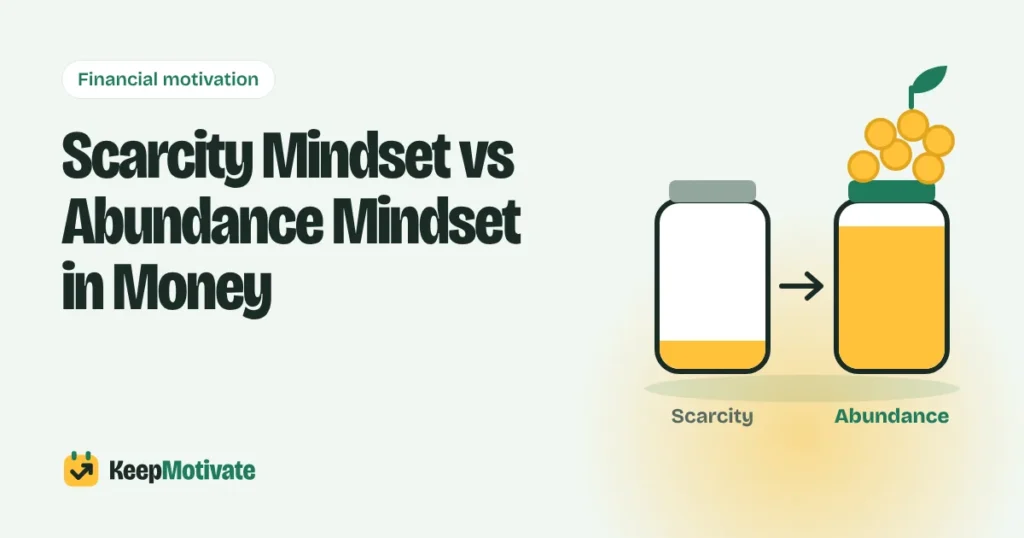
Scarcity Mindset vs Abundance Mindset in Money
Two people get the same unexpected $500. One immediately pays down a bill, then worries about the next one. The other pays the bill, puts $100 into savings and books a course that might lead to a better job. Same money, different lens.
The scarcity mindset vs abundance mindset debate gets a lot of airtime in personal development circles, sometimes with a heavy dose of wishful thinking. But underneath the slogans is some genuinely interesting research about how money pressure changes the way we think. This article looks at what each mindset means, what science says about scarcity, and how to shift toward a healthier relationship with money without pretending your bills don’t exist.
What Is a Scarcity Mindset?
A scarcity mindset is the belief, conscious or not, that there will never be enough. Money, time, opportunities: all of it feels limited and under threat.
With money, it often shows up as:
- Constant worry about bills, even when they’re covered.
- Difficulty spending on anything, including things that would help you.
- Or the opposite: spending immediately because “it’ll be gone anyway”.
- Avoiding looking at bank balances.
- Seeing other people’s success as your loss.
- Turning down opportunities because the risk feels too large.
Scarcity thinking isn’t irrational. If you grew up without enough, or you’re living with very little now, it’s a sensible response to real experience. The problem is when it outlives the situation that created it, or when it stops you making decisions that would improve things.
What Is an Abundance Mindset?
An abundance mindset is the belief that resources and opportunities can grow. It isn’t about thinking money will magically appear. It’s about believing that effort, learning and good decisions can expand what’s available to you.
In money terms, it tends to look like:
- Thinking in terms of “how can I earn more?” alongside “how can I spend less?”
- Being willing to invest in skills, health and relationships.
- Celebrating other people’s success rather than resenting it.
- Viewing setbacks as temporary.
- Making decisions based on long-term goals, not just this week.
There’s a lot of overlap with what psychologists call a growth mindset. Keepmotivate.com has a good overview of how to reprogram your mind for abundance and wealth, and a step-by-step look at Bob Proctor’s money mindset principles if you want the self-development side of the topic.
What the Research Says About Scarcity
This is where it gets interesting. Behavioural scientists have studied scarcity seriously, and the findings support a more compassionate view than “just think positive”.
Scarcity uses up mental bandwidth
In a 2013 study published in Science, researchers Anandi Mani, Sendhil Mullainathan, Eldar Shafir and Jiaying Zhao found that when lower-income participants thought about a difficult financial problem, their scores on cognitive tests fell. Wealthier participants weren’t affected the same way. In a second study, Indian sugarcane farmers did worse on the same tests before harvest, when money was tight, than after it. Princeton compared the effect to losing a full night’s sleep (Princeton University).
The point isn’t that people with less money are less capable. It’s that money stress takes up mental space, leaving less for planning and self-control.
Scarcity narrows focus
A related 2012 paper by Anuj Shah, Sendhil Mullainathan and Eldar Shafir argued that scarcity pulls attention toward immediate problems and can lead people to borrow in ways that hurt them later (Chicago Booth). It’s worth noting that one of the paper’s experiments failed to replicate in a later large-scale replication project, though the broader idea has held up across other studies.
Stress can tilt us toward short-term choices
Economists Johannes Haushofer and Ernst Fehr reviewed evidence suggesting that poverty causes stress and negative emotions, which can push decisions toward short-term thinking. That could create a feedback loop that makes poverty harder to escape (MIT News). Haushofer is careful to say material constraints matter a great deal too. Mindset doesn’t override an empty bank account.
Scarcity vs Abundance: A Side-by-Side Look
| Situation | Scarcity response | Abundance response |
|---|---|---|
| Unexpected $500 | Spend it all on whatever’s most urgent, or hoard it and feel anxious | Cover the urgent need, save a portion, consider one investment in yourself |
| A friend gets promoted | “Good for them, nothing like that happens to me” | “What did they do? What can I learn?” |
| A course costs $200 | “I can’t afford it” (end of thought) | “Could this raise my income? Can I budget for it?” |
| Checking your bank balance | Avoid it | Check it weekly, calmly |
| A financial mistake | “I’m hopeless with money” | “That cost me. What will I do differently?” |
Neither column is about how much money you have. They’re about how you respond to what you have.
Signs You’re Running on Scarcity Mode
It’s not always obvious from the inside. A few signals worth noticing:
- You make money decisions in a rush, usually when something has already gone wrong.
- You can’t name your monthly spending, but you know your balance to the cent.
- Every purchase comes with guilt, even necessary ones like shoes for work.
- You say no to anything new by reflex: a course, a job interview, a networking event.
- You feel a jolt of anxiety when someone mentions money, even casually.
None of these make you bad with money. They’re signs your brain is in protection mode. The useful question is whether that protection still matches your situation today, or whether it’s left over from a time when things were worse.
The Problem With Toxic Abundance Thinking
A word of caution. Some versions of abundance thinking slide into magical thinking: “Just believe and money will come”. That can be harmful. It can lead people to overspend, ignore debt, or blame themselves when “manifesting” doesn’t pay the rent.
A healthy abundance mindset still involves:
- A budget.
- An emergency fund.
- Realistic expectations.
- Acknowledging real constraints, like low wages or high costs.
The goal is a mind that’s calm enough to plan and hopeful enough to act. Not one that ignores reality.
How to Shift From Scarcity to Abundance
1. Build a buffer first
The fastest way to quiet scarcity thinking is to have a cushion. Even $500 in savings changes how a broken washing machine feels. The Federal Reserve found that 63% of adults would cover a $400 surprise with cash or its equivalent in 2025 (Federal Reserve, SHED 2025). Getting into that group is a practical mindset shift, not just a financial one.
2. Automate good decisions
If scarcity drains mental bandwidth, reduce the number of money decisions you need to make. Automatic savings transfers, automatic bill payments and fixed weekly spending budgets all do the thinking in advance.
3. Look at your numbers on purpose
Avoidance feeds anxiety. Pick a regular time each week to look at your balances. Use a neutral tone with yourself: “This is where I am,” not “This is terrible”.
4. Notice and rewrite money stories
Write down the beliefs you grew up with about money. “Money is the root of all evil”. “Rich people are greedy”. “We’re just not lucky”. Then ask: is this true, or is it a story I inherited? There’s a helpful piece on how self-concept remodels your income that goes deeper on this.
5. Invest in one thing that grows your future
A course, a certification, a professional connection, a healthier routine. Abundance thinking is partly about seeing that some spending is investment.
6. Practise generosity in small ways
It sounds counterintuitive, but giving something, whether time, help or a small donation, can break the feeling that there’s never enough. Keep it within your budget.
7. Give it time
Mindsets formed over years don’t change in a week. A structured programme can help. Keepmotivate.com’s free 30-day money mindset reset is one option.
Frequently Asked Questions
What is the difference between a scarcity mindset and an abundance mindset?
A scarcity mindset assumes there will never be enough, which leads to anxiety, avoidance or short-term choices. An abundance mindset believes resources can grow through effort and good decisions, which supports longer-term planning and openness to opportunities.
Is a scarcity mindset caused by poverty?
It often develops from real experiences of not having enough, and research suggests money stress uses up mental bandwidth. But people at any income level can have scarcity thinking, especially if they grew up with financial insecurity.
Can you have an abundance mindset when you’re broke?
Yes, if it’s grounded in reality. It doesn’t mean pretending you have money. It means focusing on what you can control, building a small buffer, and looking for ways to grow your income and skills over time.
Does an abundance mindset actually make you richer?
A mindset alone won’t pay bills. But thinking that supports planning, learning, saving and taking sensible opportunities tends to lead to better financial decisions over time, which can improve your situation.