
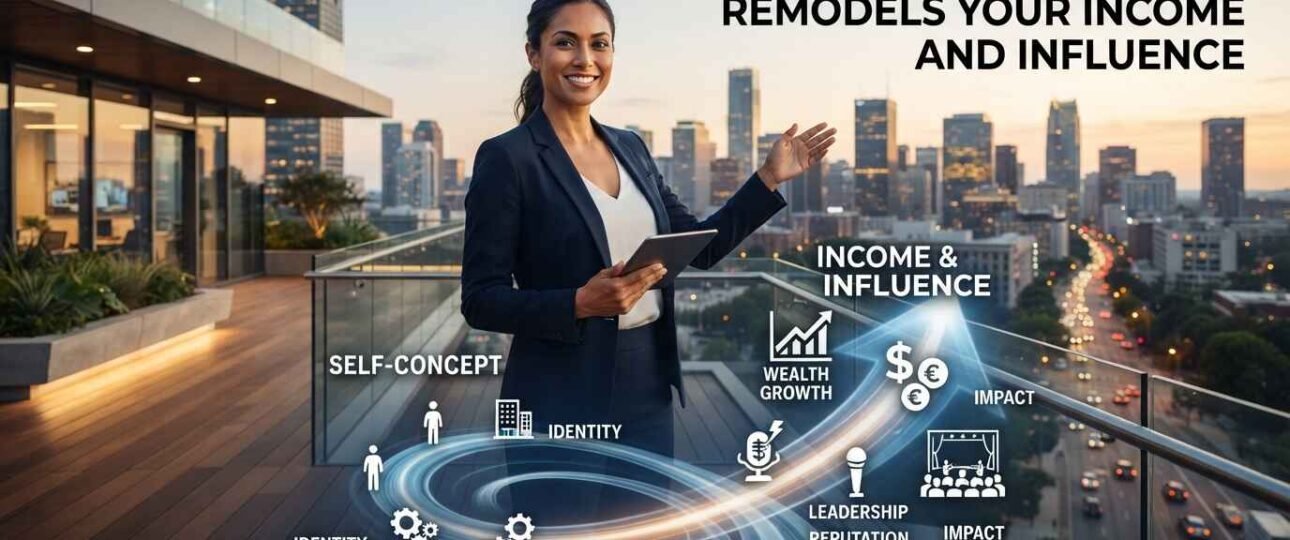
How Self-Concept Remodels Your Income and Influence
Why do two people with similar skills have such different career outcomes?
Various factors can contribute, including opportunity, education, experience, networks, economic conditions, resources, timing, and personal decisions.
Self-concept is an important issue to consider.
Self-concept refers to how you consider yourself, including your abilities, identity, strengths, shortcomings, values, and potential.
Your self-concept does not directly determine your income or influence. However, it can influence decisions and behaviors that impact professional outcomes.
In simpler terms:
How you see yourself can influence what you try, how you behave, and how others perceive your actions.
What is self-concept?
Self-concept refers to your internal sense of who you are.
It may involve beliefs such as:
“I am capable.”
“I am good at communication.”
“I am the leader.”
“I am not excellent with money.”
“I am not confident.”
“I’m creative.”
“I follow through.”
Some of these beliefs can be uplifting, while others can become restrictive.
The key idea is that self-concept is not always fixed.
People can learn new skills, have new experiences, receive feedback, and modify their perspective on themselves.
How Self-Concept Affects Income
Many external factors influence income, thus claiming that self-concept alone influences earnings is false.
However, self-concept can influence earnings-related actions.
1. Your self-concept influences what you attempt
- Imagine someone who believes:
- “I’m not capable of running a business.”
- They may never start one.
- Another person would think:
“I’m not sure how to run a business yet, but I can learn.”
The second belief allows for action.
They may provide company model research, sales training, mentorship, skill development, and offer testing.
The distinction begins with perception, but it gains significance through behavior.
2. Self-Concept Can Influence Pricing Confidence
Freelancers, consultants, coaches, producers, and business owners regularly need to express the worth of their job.
A person with a low professional self-image may:
Offer constant discounts.
Avoid discussing prices.
Apologize for the fees• Accept unfit clientele.
Work beyond stipulated scope without compensation.
A better professional self-concept may facilitate straightforward value communication and professional negotiation.
However, confidence must be based on actual value, knowledge, outcomes, and market need.
3. Self-Concept Affects Career Decisions
Your self-perception can impact which chances you seek.
Consider the differences between:
“I am not leadership material.”
“I can build leadership skills.”
The second statement does not ensure a promotion.
However, it can promote behaviors like accepting responsibility, seeking feedback, improving communication skills, and volunteering for tough projects.
4. Self-Concept Influences Persistence
Setbacks are inevitable when pursuing a significant objective.
A person interprets failure as:
The statement “This proves I am incompetent” may be stopped.
A person interprets failure as:
“This technique did not work.” “What can I learn?”
may continue to experiment.
This divergence can have serious long-term effects.
Self-Conception and Influence
Income is just one aspect of professional success.
Influence is another.
Influence is the ability to influence other people’s thoughts, decisions, behaviors, or perceptions.
It can develop in the following ways:
- Expertise
- Communication.
Credibility
Trust.
Relationships
Maintain consistency
Leadership - Visibility
- High reliability
Self-concept can influence your willingness to acquire and show these abilities.
Confident individuals may be more inclined to share their views and get visibility.
Publish articles
Speak publicly.
Create videos- Networking
Lead meetings.
Share opinions. - Teach others
Create communities
Visibility opens up opportunity for individuals to find your skills.
However, confidence alone does not build influence.
Competence combined with credibility, communication, and consistency results in stronger foundations for influence.
The Loop of Self-Concept Feedback
Self-concept can be effectively understood as a feedback loop.
Step 1: Belief “I can learn challenging stuff.”
Step 2: Take Action
You take on a difficult task.
Step 3: Knowledge
You learn and receive comments.
Step 4: Enhancement
Your abilities grow.
Step 5: Proof
You now have proof that you are capable of managing difficult circumstances.
Step 6: Improved Self-Perception
You start to see yourself as more capable.
This results in a cycle:
Self-concept → behavior → experience → proof → a more robust self-concept
It is also possible for the reverse cycle to take place.
Avoidance may result from a negative belief.
Experience is prevented by avoidance.
The belief is strengthened by inexperience.
For this reason, altering one’s conduct might be just as crucial as altering one’s thinking.
How to Develop a More Robust Self-Concept
1. Quit Using Your Present Skill Level to Define Yourself
Rather than stating:
“I’m not very good at sales.”
Try:
“I’m currently honing my sales skills.”
A growth-oriented identity is produced as a result.
2. Honor Your Own Promises
Consistent behavior fosters self-trust.
You may reinforce the idea that you are incapable of relying on yourself if you consistently set objectives and then give up on them.
Start with little obligations.
If you commit to learning a skill for half an hour, follow through.
Little victories add up.
3. Create Genuine Competence
Certainty without competence is delicate.
In case you need to feel more certain in your calling, ended up superior at what you are doing.
Examined.
Hone.
Take courses.
Work on genuine ventures.
Look for input.
Degree your advance.
Competence gives certainty a establishment.
4. Alter Your Environment
The individuals around you’ll impact your convictions and behavior.
Spend time with individuals who energize learning, responsibility, imagination, and solid desire.
This doesn’t cruel encompassing yourself only with individuals who concur with everything you say.
Constructive feedback can be greatlyimportant.
5. MakeProve
Rather than attempting to persuade yourself simply are as of now fruitful, make prove of advance.
Keep track of:
- Completed ventures
- New aptitudes
- Positive input
- Client comes about
- Professional points of reference
- Difficult discussions you taken care of
- Goals you accomplished
Your brain can learn from genuine encounters.
Simple Self-Esteem Exercises
Create three statements that begin with the phrase “I’m the one…”
For example:
- I’m the one who keeps learning.
- I’m the one who gets things done.
- I’m the one who creates value for others.
Choose one of these statements and turn it into a daily action.
For example:
Identity: “I’m the one who keeps learning.”
Action: “I will spend 30 minutes every day developing valuable professional skills.”
The aim is to show your true self through your actions.
Does self-esteem really determine income?
Not by itself.
This is an important point.
Your income depends on several factors, including:
- The industry you are in;
- The balance between demand and supply;
- Where you live;
- Your level of education;
- Your experience;
- The state of the economy;
- The economic system in place;
- Who you work for;
- Your professional connections;
- The tools and resources available to you;
- Your abilities;
- Your ability to negotiate;
- And also luck and timing.
Therefore, self-image should not be seen as a quick fix for financial success, but as one of the key factors that shape your behavior.
You can’t just expect your income to rise by thinking positively.
But you can change the beliefs that guide the actions you take to reach your financial goals.
Does Self-Concept Determine Your Influence?
Not by itself.
Influence is built through value, expertise, relationships, communication, credibility, and consistent behavior.
Having a strong self-concept can help you step forward and show these qualities more easily.
However, long-term influence comes from what you actually contribute—not just how confident you feel.
Final Words
Your self-concept may not alone determine your income or influence, but it can shape the decisions you make each day.
If you believe you can learn, you are more likely to put in the effort.
If you believe your work adds value, you may be more willing to share that value.
If you believe you can handle rejection, you may be more willing to take on new opportunities.
If you believe you can improve, setbacks become learning experiences rather than failures.
The goal is not to create an unrealistic self-image.
The goal is to develop a realistic, capable, and growth-oriented self-concept—and support it with consistent actions.
Ultimately:
See yourself as someone who can grow.
Build skills that back up that belief.Take meaningful steps.
Create results.Then let those results reshape your self-concept again.